Networking/CCNA Part 3: A Guide to Communication & Layers
A Guide to Communication & Layers
Understanding how data moves across a network is the bedrock of IT. Whether you’re refreshing your skills or studying for certifications, these core concepts are essential.
1. Key Terminology
To understand networking, we first need to speak the language:
- Protocol: A set of rules and regulations that allow multiple devices to communicate at the same layer level.
- Header: A “tag” added to data (such as an IP Address) that contains control information.
- Encapsulation: The process of wrapping data with headers and sometimes trailers (blocks of specific data).
- The Rule: The sending side encapsulates data; the receiving side de-encapsulates it.
Analogy: Think of layers like a corporate office. A lower layer provides services to upper layers (like a clerk to a manager). Communication between the same layers is like a secretary in one department talking to a secretary in another.
2. Data Flow & Protocol Data Units (PDU)
As data moves down the OSI layers, its name and form change. These specific forms are called PDUs.
| Layer(s) | PDU Name | Process |
|---|---|---|
| Application + Presentation + Session | PDU / Data | The raw information. |
| Transport | Segments | Converts data to Audio, Video, etc. |
| Network | Packets | Logical addressing is added. |
| Data Link | Frames | Prepares for physical transit. |
| Physical | Bits | Electrical or optical signals. |
3. Network Devices & Layer Levels
Each piece of hardware operates at a specific level:
- Router (L3): Operates on the Network Layer. It integrates LAN & WAN and acts as a Unicast device for data.
- Switch (L2): Operates on the Data Link Layer.
- Hub (L1): Operates on the Physical Layer.
4. Transmission Types
How is data distributed?
- Unicast: One-to-One communication.
- Multicast: One-to-a-Few (Group).
- Broadcast: One-to-All (Everyone).
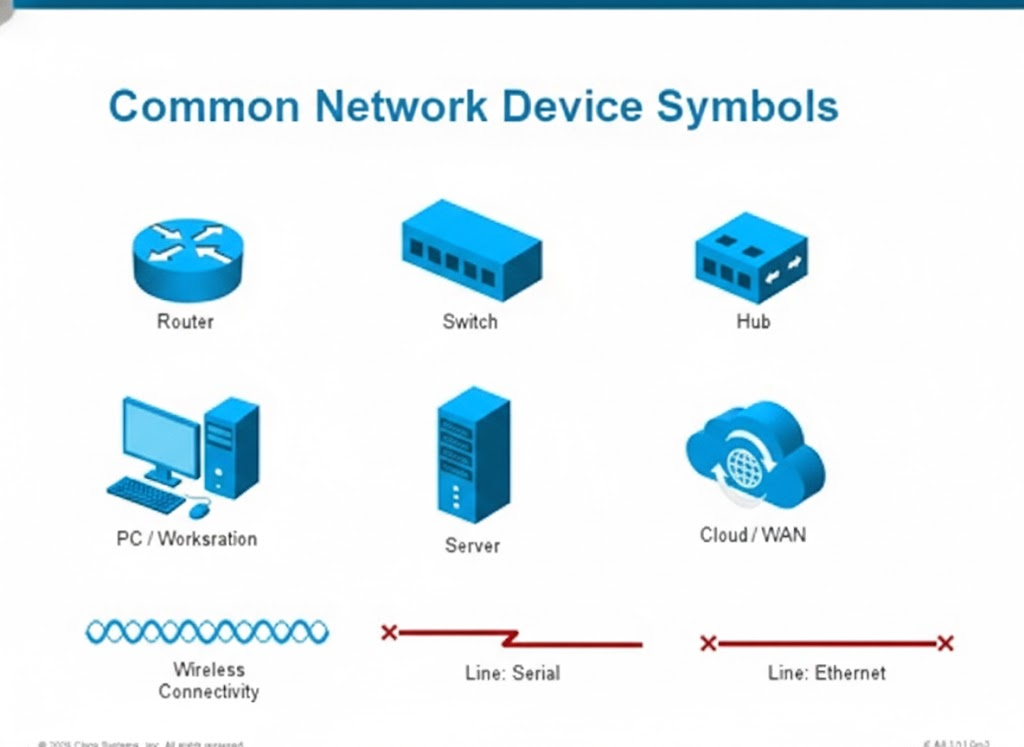
5. A few symbols to remember
6. The Core of Information Exchange
Networking Essentials: The fundamental purpose of networking is information exchange, such as a bank’s DB and App Servers communicating with an ATM via Fiber, Radio, or Satellite; key terms include:
- Routers, which direct traffic using the best possible route
- Routing, the process of forwarding traffic along that path using best possible path
- Ethernet Standards, which define speeds as Ethernet (10 Mb), Fast Ethernet (100 Mb), and Gigabit Ethernet (1000 Mb / 1 Gb).
| Type | Speed |
|---|---|
| Ethernet | 10 Mb |
| Fast Ethernet | 100 Mb |
| Gigabit Ethernet | 1000 Mb (1 Gb) |
Network Layout Sketch
A typical setup involves a Router integrating a local network (LAN) with a wider network (WAN), connecting various PCs and servers.