Networking/CCNA Part 1: Foundations & The OSI Model
An introduction to networking basics, part1 involving some key terms and OSI model.
What is Networking?
Networking is the connectivity between devices for communication. Through this connectivity, we exchange Information, which can be:
- Audio
- Video
- Data
The OSI Model
The OSI (Open Systems Interconnection) is a conceptual model and was introduced in 1984. It is a layered approach that helps us:
- Understand Behavior: It provides a universal map for how data travels.
- Troubleshoot: It allows engineers to “divide and conquer.” If you can ping an IP (Layer 3) but can’t browse a site (Layer 7), you know where to start looking.
- Standardize: It ensures Interoperability—allowing a Cisco router to talk to a Juniper switch or a Linux server.
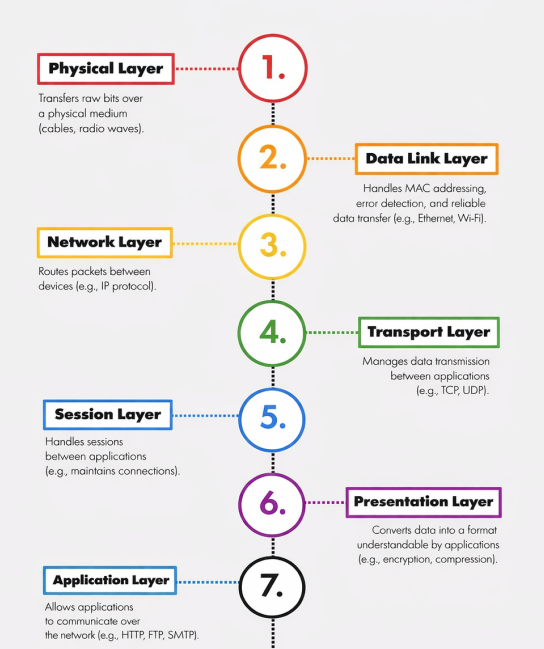
The 7 Layers & Their Functions
Each layer handles a specific task and uses a specific Protocol Data Unit (PDU).
| Layer # | Name | PDU | Core Function |
|---|---|---|---|
| 7 | Application | Data | Network services for applications (HTTP, DNS, SSH). |
| 6 | Presentation | Data | Syntax, encryption (SSL/TLS), and GIF/JPEG formatting. |
| 5 | Session | Data | Start, stop, and restart “dialogues” between hosts. |
| 4 | Transport | Segments | Port numbers; Error recovery (TCP) vs. Speed (UDP). |
| 3 | Network | Packets | Logical addressing (IPv4/IPv6) and path selection. |
| 2 | Data Link | Frames | Physical addressing (MAC) and Error Detection (FCS). |
| 1 | Physical | Bits | Physical medium (Copper, Fiber, Wireless). |
Note: Layers 5-7 are often referred to as the Upper Layers (Software-focused), while Layers 1-4 are the Lower Layers (Network-focused).
How Communication Works
When Host A sends data to Host B, it undergoes two critical processes:
- Encapsulation: Data moves from Layer 7 down to Layer 1. Each layer adds a “header” (like an envelope) containing necessary control info.
- De-encapsulation: The receiving host moves from Layer 1 up to Layer 7, stripping away headers to reveal the original data.
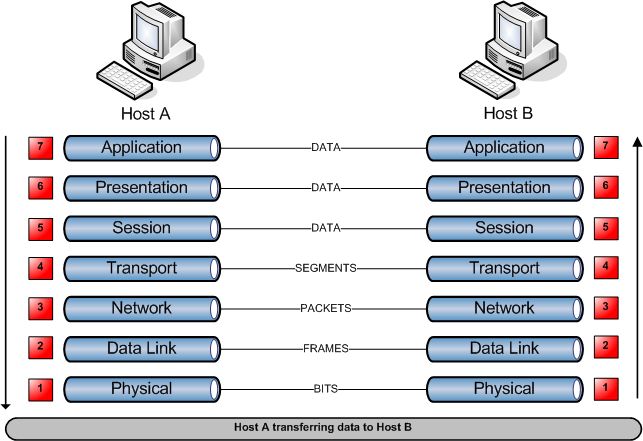
Remember: Data flows down the stack on the sender’s side and up the stack on the receiver’s side.
What’s Next? In the next post, we will look at the TCP/IP Model—the real-world version of this theoretical framework.